
Water has always been the most consequential variable in landscape management, and in commercial settings, how it is distributed determines the health of an entire outdoor environment. Traditional irrigation methods apply water on fixed schedules regardless of what the landscape actually needs, which leads to overwatering in cooler periods, underwatering during heat spikes, and costs that accumulate without producing better results.
Smart irrigation systems change that relationship entirely. Instead of running on timers, they respond to real conditions: soil moisture levels, ambient temperature, evaporation rates, and live weather data. For commercial properties managing large outdoor environments, this shift from schedule-based to condition-based watering is not a minor upgrade. It is a fundamentally different way of managing one of the most resource-intensive aspects of property maintenance.
How Does Smart Irrigation Work for Commercial Projects?
Conventional irrigation relies on buried pipe networks, zone valves, and controllers programmed by maintenance staff. The system follows a fixed schedule and applies water whether the ground needs it or not. That gap between what is programmed and what the landscape actually requires is where water waste and plant stress both originate.
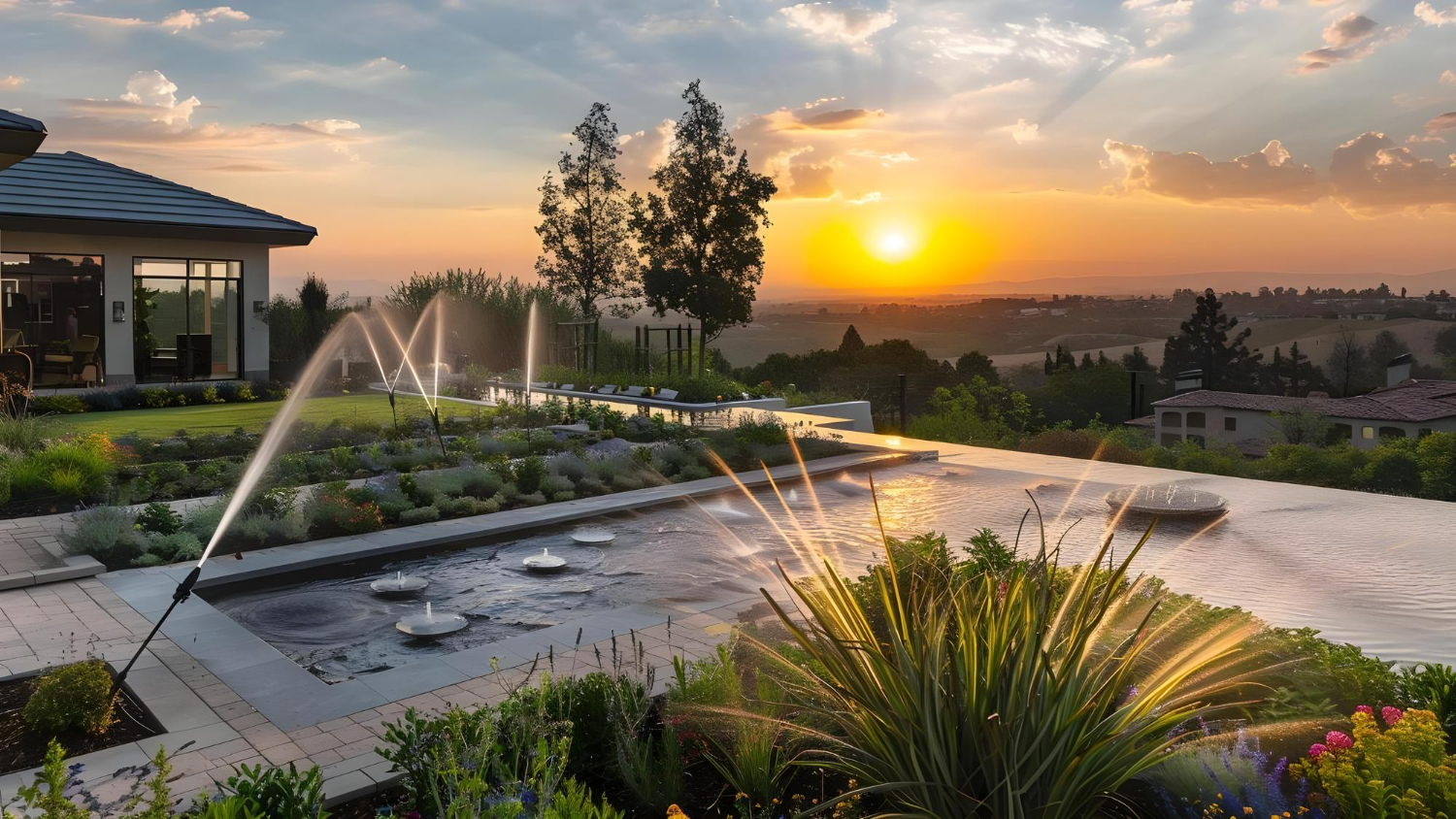
Smart irrigation for commercial properties introduces a layer of environmental intelligence into that process. Weather-based controllers, soil moisture sensors, flow sensors, and leak-detection technology work together to gather real-time data and adjust watering schedules accordingly. When soil is already adequately moist, the system holds back. When conditions are drier than expected, it responds. The irrigation follows the landscape, not the other way around.
For multi-site commercial operators, automated irrigation systems also offer centralized cloud-based control. Property managers can monitor water usage, adjust schedules, and receive alerts across multiple locations from a single platform, without requiring manual intervention at each site. That operational efficiency is increasingly significant for large-scale developments where landscape management spans extensive outdoor areas.
Benefits of Smart Irrigation for Commercial Properties
The performance advantages of smart water management show up across several dimensions of commercial property operations. Better water distribution improves plant health, reduces utility expenditure, and lowers the environmental footprint of a site all at once.
Here is where those benefits are most clearly seen.
Water Conservation
Water efficient landscaping through smart systems can reduce outdoor water consumption by 20% to 50%, according to EPA research. The reduction comes from eliminating the chronic overwatering that fixed-schedule systems produce, ensuring that irrigation happens only when soil conditions and weather data indicate it is necessary. For large commercial sites with extensive planted areas, that percentage represents a substantial volume of water saved annually.
Cost Savings
Lower water consumption translates directly into lower utility costs, but the savings extend further. Overwatering damages root systems, accelerates plant deterioration, and increases the frequency of replacement, all of which carry their own costs. Commercial irrigation solutions that maintain appropriate soil moisture keep planting healthier over time, reducing the remedial expenditure that poor irrigation planning tends to generate.
Healthier Landscapes
Plants watered in response to their actual needs perform better than those on fixed schedules. Consistent soil moisture at appropriate levels supports root development, reduces stress during extreme heat, and produces the kind of stable, healthy landscape that retains its quality across seasons. For commercial properties where outdoor environments contribute to first impressions and tenant experience, that sustained quality has visible value.
Environmental Impact
Sustainable commercial landscaping requires more than choosing the right plants. The infrastructure delivering water to those plants matters equally. Smart irrigation reduces runoff, prevents water pooling on paved surfaces, and minimizes the energy associated with pumping excess water through a system. In water-scarce regions, responsible outdoor irrigation systems are not simply a sustainability choice. They are an operational necessity.
How Smart Irrigation Is Transforming Saudi Arabia’s Landscaping
Smart irrigation in Saudi Arabia has moved from a niche consideration to an operational standard on significant commercial and urban developments. Systems drawing on soil moisture data, evaporation rates, and live weather conditions are replacing fixed-schedule approaches across hospitality, retail, and mixed-use projects. During peak summer heat, these systems increase watering frequency automatically. On cooler days, they scale back. The landscape receives what it needs, and nothing beyond that.
The longer-term implications are considerable. Research indicates that smart water management systems can reduce water consumption by up to 40%, which in Saudi Arabia’s desert climate carries both environmental and economic significance.
As Vision 2030 continues to drive large-scale development across the Kingdom, responsible water use in outdoor environments is increasingly a design requirement rather than an afterthought. Demand for skilled landscape irrigation solutions is rising accordingly, and the projects setting the standard are those where irrigation planning is integrated from the earliest design stages.
Why The Landscape Company Offers the Best Smart Irrigation for Commercial Properties
Irrigation systems for commercial properties perform best when the design, installation, and planting strategy are developed together rather than in sequence. The Landscape Company approaches irrigation as part of its broader soft landscaping services, integrating planting and water distribution planning from the outset of each project. Every system is designed and installed to match the specific requirements of the site.
That integration matters because irrigation is not an isolated infrastructure decision. It affects soil health, root establishment, plant selection viability, and long-term maintenance requirements. As a landscaping company in Saudi Arabia working across commercial, hospitality, entertainment, and urban development projects, we bring the technical depth to specify automated irrigation systems that are scaled correctly, installed with precision, and calibrated to the environmental conditions of each site.
Conclusion
Smart irrigation systems represent one of the most measurable improvements available to commercial property managers looking to reduce operational costs and improve landscape performance simultaneously. The technology eliminates the guesswork from water distribution, replaces fixed schedules with real-time environmental responses, and delivers consistent plant health across large and varied outdoor environments.
For developments in Saudi Arabia, where heat, water scarcity, and the scale of outdoor environments create compounding challenges, irrigation planning is not a finishing detail. It is a foundational decision that shapes how a landscape performs for the life of the property. Getting it right from the start is considerably more efficient than correcting it later.
FAQs
1.What is a smart irrigation system and how does it differ from a traditional one?
A smart irrigation system uses sensors, weather data, and automated controllers to water landscapes based on real-time conditions rather than fixed schedules. Traditional systems run on timers regardless of soil moisture or weather, which frequently results in overwatering and unnecessary water expenditure.
2.How much water can smart irrigation systems save for commercial properties?
Research indicates that automated irrigation systems can reduce outdoor water use by 20% to 50% compared to conventional approaches. The exact saving depends on site size, plant types, and the baseline efficiency of the previous system.
3.Are smart irrigation systems suitable for large commercial developments?
Yes, and they are particularly well-suited to large sites where manual irrigation management becomes difficult to maintain consistently. Cloud-based control platforms allow property managers to oversee multiple zones or multiple locations from a single interface.
4.How does smart irrigation contribute to sustainable commercial landscaping?
By applying water only when and where it is needed, sustainable commercial landscaping through smart irrigation reduces runoff, prevents overwatering damage, and lowers the energy consumption associated with excess water distribution. It also supports broader environmental commitments increasingly required by development standards in Saudi Arabia.
5.Can smart irrigation systems be retrofitted into existing commercial landscapes?
In most cases, yes. Existing pipe networks and zone infrastructure can often be upgraded with smart controllers, sensors, and cloud-connected management systems without requiring full reinstallation. A qualified landscaping company in Saudi Arabia will assess the existing setup before recommending the most efficient upgrade path.
6.What role does irrigation planning play in the overall landscape design process?
Irrigation planning should be integrated into the landscape design from the earliest stages rather than added after planting decisions are made. The water requirements of selected species, soil conditions, and site orientation all influence how an irrigation system should be zoned, scheduled, and specified to perform effectively over time.