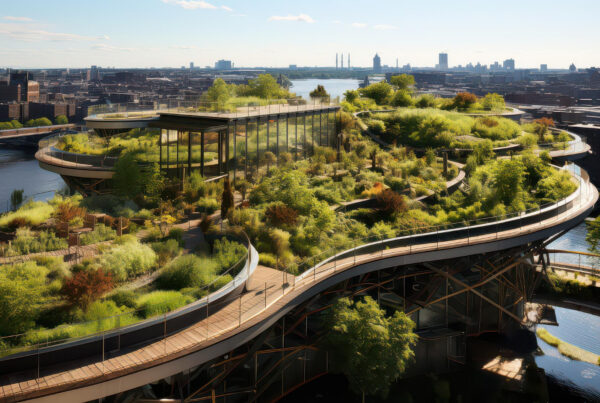


A green roof isn’t created by simply placing plants over a waterproofed roof. That assumption is where a surprising number of rooftop planting projects run into trouble, usually well after installation.
For a commercial or institutional building, it is a coordinated roof system that has to carry additional loads, manage water, protect waterproofing, support vegetation, and remain accessible for maintenance. Each of these requirements shapes the others, which is why a green roof works best when it is designed as a single system from the start, rather than assembled layer by layer without a shared plan.
What Is a Green Roof System?
A green roof system is a purpose-built roof assembly that supports living vegetation on top of a structure, using a series of engineered layers to manage water, protect the building, and sustain plant life. It is distinct from simply placing potted plants or a garden bed on a rooftop, since every layer beneath the visible greenery is doing structural and functional work.
The system is designed to achieve several things at once: reducing heat gain into the building, managing stormwater on site, protecting the waterproofing membrane from UV exposure and physical wear, and creating usable green space in a location that would otherwise sit unused. Getting these outcomes together, rather than any one in isolation, is what separates a well-designed green roof from a rooftop planter that happens to be large.
What Should a Green Roof Design Plan Consider?
A green roof design plan succeeds or fails based on decisions made before any layer is installed, not on plant selection at the end. Several factors need to be understood together, since each one constrains the choices available in the others.
Here is what needs to be assessed early.
-
Define the purpose of the roof
Whether the roof is meant purely for environmental performance or for public and guest access changes almost every decision that follows. This should be settled before structural or planting decisions begin.
-
Assess structural capacity
The building’s structure needs to be evaluated for the additional saturated weight of substrate, plants and retained water, not just the dry weight of materials. This assessment determines which types of green roof are even viable.
-
Review the existing roof and waterproofing
The condition of the existing roof and its waterproofing membrane needs to be confirmed before any green roof layer is added on top. Retrofitting over compromised waterproofing tends to create hidden problems that surface much later.
-
Understand climate and environmental exposure
Sun exposure, wind loading and local rainfall patterns all influence which plants, substrate depth and drainage capacity the roof needs. This is especially critical in a climate as demanding as this region’s.
-
Plan drainage and water retention
The roof needs a defined path for excess water to leave the system, along with enough retention capacity to support plants between watering cycles. Poor drainage planning is one of the most common causes of green roof failure.
-
Determine irrigation requirements
Even drought-tolerant planting schemes typically need some level of supplemental irrigation in this climate, and that demand has to be planned for from the start. Irrigation infrastructure is far easier to integrate during design than to retrofit later.
Types of Green Roofs and Where They Are Used
The types of green roofs are generally grouped by substrate depth and level of access, and each type suits a different combination of building, budget, and intended use. Choosing between them starts with the structural and purpose decisions made earlier.
Here is how the main categories differ.
-
Extensive green roofs
These use a shallow substrate, typically supporting low groundcovers, sedums or drought-tolerant grasses that require minimal maintenance once established. They add relatively little structural load, which makes them suitable for a wider range of existing buildings. Extensive roofs are generally not designed for regular public access, focusing instead on environmental performance.
-
Semi-intensive green roofs
Sitting between extensive and intensive systems, these support a broader plant palette, including small shrubs and perennials, with a moderate substrate depth. They require more structural capacity and irrigation than extensive systems but offer greater planting variety and visual impact. This category often suits developments looking for a balance between performance and appearance.
-
Intensive green roofs
These support the widest range of vegetation, including trees, shrubs and lawn areas, within a deep substrate that functions much like ground-level soil. They demand significant structural capacity, irrigation and ongoing maintenance, closer to a rooftop garden than a planted roof surface. Intensive systems are typically chosen for accessible, high-visibility spaces where the roof itself becomes part of the building’s usable area.
How Do Green Roofs Perform in Saudi Arabia’s Climate?
Saudi Arabia’s climate presents real challenges for rooftop planting, including intense solar radiation, extreme summer heat, low rainfall and high rates of evaporation. Substrates need to hold enough moisture and nutrients to keep plants alive through long dry periods, while remaining light enough not to overload the structure beneath them.
The performance upside is significant when this is done correctly. Studies on hot, dry climates have found that green roofs in Saudi Arabia can meaningfully reduce a building’s cooling load, since vegetation and substrate insulate the roof from direct solar heat gain far more effectively than a bare surface.
Advances in engineered lightweight substrates, drip irrigation, and drought-tolerant native planting are steadily making rooftop greening a more realistic option across the Kingdom’s commercial and institutional buildings, not just a concept borrowed from cooler climates.
How to Choose Plants for a Saudi Green Roof
Plant selection for a Saudi green roof needs to start from the region’s conditions, not from a plant palette borrowed from a temperate or Mediterranean project. Species need to withstand long summers of intense heat and sun, tolerate low and irregular rainfall, and cope with the wind and dust exposure typical of an elevated rooftop position.
Native and regionally adapted species, including hardy groundcovers, succulents, and drought-tolerant shrubs, tend to establish and survive far better here than imported ornamental varieties chosen mainly for appearance.
How Do Drainage and Irrigation Work Together?
Drainage and irrigation on a green roof are not separate systems working independently, but two halves of the same water management strategy. Drainage layers are designed to remove excess water quickly enough to prevent root saturation and structural loading beyond what the roof can safely carry, while also retaining a controlled amount of moisture for the plants to draw on between watering cycles. Getting this balance wrong in either direction, too much retention or too little, tends to show up quickly as either waterlogged substrate or stressed, dying plants.
Irrigation then supplements what natural rainfall and the drainage layer’s retention capacity cannot provide on their own, which in an arid climate is most of the water the plants will ever receive. A well-integrated system uses irrigation efficiently, often through drip lines placed close to the root zone, so water reaches the plants directly rather than being lost to evaporation across the surface.
Can Green Roofs Improve Building Energy Performance?
Green roofs can meaningfully improve a building’s energy performance, primarily by reducing the amount of heat that transfers through the roof into the occupied space below. Vegetation and substrate act as insulation and shading combined, lowering roof surface temperatures compared to a bare, exposed roof and reducing the cooling load a building’s air conditioning system has to carry, particularly during peak summer months.
In hot, dry climates like this one, where cooling accounts for a substantial share of a commercial building’s energy use, this effect can translate into a genuinely measurable reduction in energy demand, making green roofs a design decision with real operational value, not just an aesthetic one.
Green Roofs, Biodiversity and Sustainable Building Goals
Beyond their thermal benefits, green roofs create habitat and planting diversity in places that would otherwise contribute nothing to a site’s ecology, which matters increasingly in dense urban developments with limited ground-level green space. They also align directly with sustainable building certifications and national environmental priorities that are placing growing emphasis on livability, reduced emissions, and improved urban quality of life.
For commercial and institutional developments working toward these goals, a well-designed green roof offers a rare opportunity to combine measurable environmental performance with a genuine improvement to how a building looks and feels.
Common Green Roof Design Mistakes
Most green roof problems trace back to a handful of decisions made in the wrong order, usually because plant selection or aesthetics were prioritized before the underlying system was properly assessed. Recognizing these patterns early prevents costly corrections later.
Here are the mistakes that come up most often.
-
Choosing plants before assessing the roof
Selecting a planting scheme before confirming structural capacity and waterproofing condition often means the plants have to be changed later anyway. The roof’s constraints should always come first.
-
Ignoring saturated structural loads
Calculating structural capacity using dry material weight, rather than fully saturated weight after rainfall or irrigation, significantly underestimates the load the building actually needs to carry. This is one of the most serious and avoidable design errors.
-
Treating waterproofing as an afterthought
Waterproofing quality determines whether the entire system succeeds, yet it is sometimes treated as a given rather than verified before construction begins. Any compromise here tends to surface as a serious, expensive problem later.
-
Using generic plant palettes
Applying a plant list developed for a different climate rarely survives contact with Saudi Arabia’s heat, sun and low rainfall. Palettes need to be selected specifically for arid, high-exposure rooftop conditions.
-
Assuming extensive means zero irrigation
Even shallow, low-maintenance extensive systems typically need some supplemental irrigation in this climate to keep plants healthy through summer. Treating extensive as maintenance-free tends to lead to premature plant loss.
Conclusion
A green roof performs well when it is treated as an integrated system from the first design conversation, not as a planting layer added once the architecture and structure are already fixed. Structural capacity, waterproofing, drainage, irrigation and plant selection all depend on each other, and skipping the coordination between them is where most rooftop planting projects run into trouble.
At The Landscape Company, we approach green roof design as part of a building’s broader landscape and environmental strategy, not a standalone feature layered on at the end. Whether the goal is energy performance, biodiversity, or simply usable green space on a commercial or institutional building, the right outcome starts with understanding the roof itself, long before a single plant is selected.
FAQs
- What are the main types of green roofs?
The three main types are extensive, semi-intensive and intensive, distinguished mainly by substrate depth, plant variety and level of access. Extensive systems are the lightest and lowest maintenance, while intensive systems support the widest range of vegetation.
- What is included in a green roof design plan?
A design plan covers the roof’s intended purpose, structural capacity, existing waterproofing condition, climate exposure, drainage strategy and irrigation requirements. These factors are assessed together before plant selection or layer specification begins.
- Does a green roof need irrigation in Saudi Arabia?
Yes, in most cases. Even drought-tolerant planting schemes typically need some supplemental irrigation to stay healthy through the region’s long, intense summers.
- Which plants are suitable for green roofs in Saudi Arabia?
Native and regionally adapted species, including hardy groundcovers, succulents and drought-tolerant shrubs, generally perform best. Plant palettes borrowed from cooler or wetter climates tend to struggle under local conditions.
- How much weight does a green roof add to a building?
The added weight depends on the type of system, ranging from relatively light extensive roofs to significantly heavier intensive systems with deep substrate and larger plants. Structural assessments need to account for the fully saturated weight, not just dry material weight.
- Does a green roof protect the waterproofing membrane?
Yes, when designed correctly, the layers above the membrane shield it from direct UV exposure and physical wear, which can extend its working life. This protection depends on the waterproofing being sound and properly installed to begin with.
- How does green roof drainage work?
A dedicated drainage layer removes excess water that the substrate and plants do not retain, preventing waterlogging and excessive structural loading. This layer works alongside irrigation to keep moisture levels balanced for plant health.